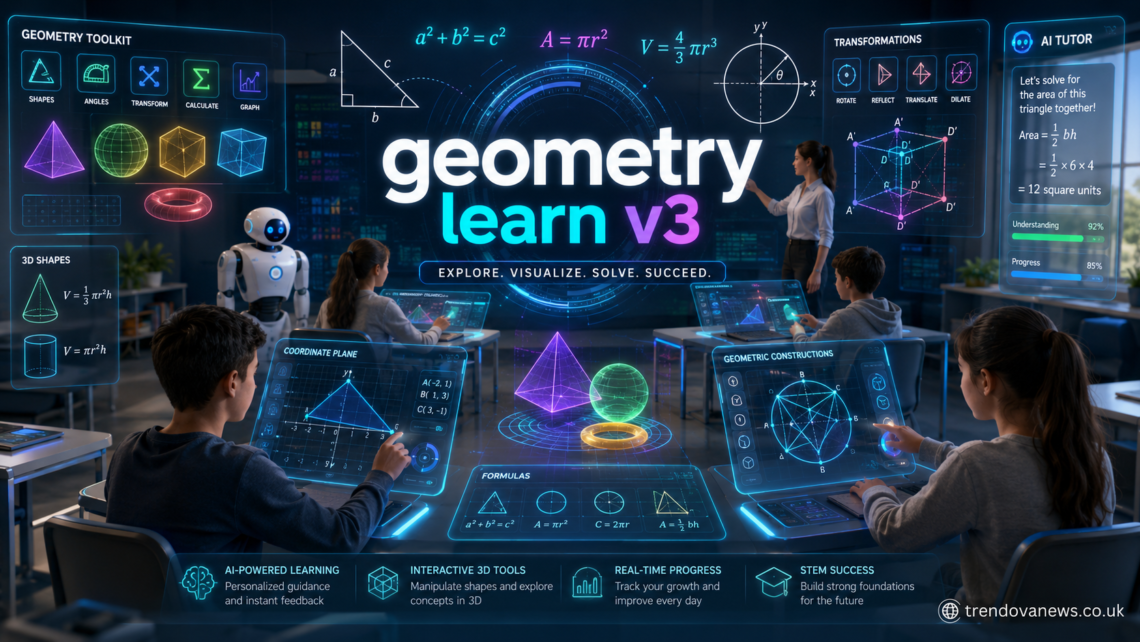
Geometry has always been one of the most important branches of mathematics because it helps people understand shapes, measurements, spatial relationships, and logical reasoning. From ancient civilizations building pyramids and monuments to modern engineers designing skyscrapers and software developers creating 3D graphics, geometry has remained essential across generations. However, despite its importance, many students struggle with geometry because traditional teaching methods often rely heavily on memorization, static diagrams, and textbook-based explanations. Geometry Learn V3 has emerged as a modern solution designed to transform the way students interact with geometry concepts through visual learning, dynamic interaction, and technology-driven education.
In recent years, educational technology has advanced rapidly, creating new opportunities for interactive learning experiences. Geometry Learn V3 is part of this growing shift toward digital mathematics education that focuses on conceptual understanding instead of rote memorization. The platform combines interactive geometry tools, adaptive learning systems, visual demonstrations, and guided explanations to help learners understand difficult concepts more naturally. As students increasingly rely on online learning platforms for academic improvement, Geometry Learn V3 has gained attention for making geometry more engaging, accessible, and practical for learners of all levels.
Understanding the Purpose of Geometry Learn V3
Geometry Learn V3 is designed to simplify geometry learning through interactive digital experiences that allow students to explore mathematical concepts visually. Unlike traditional methods where students passively observe diagrams in textbooks, the platform encourages active participation. Learners can manipulate shapes, test measurements, experiment with transformations, and observe geometric relationships in real time. This interactive structure helps students understand how geometry works rather than simply memorizing formulas and theorems.
The purpose of Geometry Learn V3 extends beyond basic classroom instruction. The platform aims to improve mathematical reasoning, spatial visualization, and analytical thinking by allowing learners to interact directly with geometric models. Many students struggle with abstract concepts because they cannot easily visualize the movement or behavior of geometric figures. Geometry Learn V3 addresses this issue by offering dynamic demonstrations that make concepts such as angles, symmetry, reflections, rotations, and coordinate geometry easier to understand.
Another major goal of the platform is accessibility. Traditional tutoring and advanced math programs can be expensive or difficult to access in certain regions. Digital learning tools like Geometry Learn V3 provide students with flexible opportunities to practice geometry at their own pace from almost anywhere with internet access. This accessibility has become especially important in the era of remote education and self-paced online learning.
The Evolution of Digital Geometry Education
The evolution of geometry education has changed dramatically over the last two decades. Earlier learning systems relied mostly on printed materials, whiteboard demonstrations, and repetitive exercises. While these methods were effective for some learners, they often failed to support students who needed more visual or hands-on instruction. The development of digital learning technologies introduced new possibilities for teaching mathematics in more interactive ways.
Modern geometry software now allows students to construct shapes, test theorems, and observe mathematical relationships dynamically. Geometry Learn V3 represents an advanced stage of this evolution by integrating interactive simulations with intelligent educational guidance. Instead of simply displaying information, the platform encourages experimentation and exploration, which helps students build stronger conceptual understanding. This shift reflects a broader transformation in education where active learning is increasingly valued over passive memorization.
The rise of educational technology has also influenced how schools and teachers approach mathematics instruction. Interactive geometry platforms are now used in classrooms, tutoring centers, and independent study environments worldwide. Teachers recognize that students often learn faster when they can visualize mathematical relationships and receive immediate feedback on their work. Geometry Learn V3 fits into this educational trend by combining technology, visualization, and guided problem-solving into one integrated learning environment.
Interactive Learning and Visual Geometry Concepts
One of the strongest features of Geometry Learn V3 is its emphasis on interactive learning. Geometry is naturally visual, and many students find it difficult to understand abstract mathematical concepts through text alone. By allowing learners to interact directly with geometric figures, the platform transforms complex ideas into more understandable visual experiences. Students can move points, resize shapes, rotate objects, and observe how geometric properties change under different conditions.
Interactive learning improves comprehension because students actively participate in the educational process. Instead of reading a formula and trying to memorize it, learners can observe how formulas behave in real situations. For example, students studying triangle properties can manipulate side lengths and angles while observing how these changes affect area, perimeter, and symmetry. This visual feedback strengthens understanding and reduces confusion.
Visual learning is especially important for topics involving transformations and spatial reasoning. Concepts such as reflections, dilations, coordinate geometry, and three-dimensional modeling are much easier to understand when students can see them dynamically. Geometry Learn V3 uses animated demonstrations and interactive diagrams to make these concepts more approachable. As a result, learners often gain confidence more quickly and develop stronger problem-solving abilities.
How Geometry Learn V3 Improves Student Engagement
Student engagement is one of the biggest challenges in mathematics education. Many learners lose interest in geometry because traditional instruction can feel repetitive, difficult, or disconnected from real-world applications. Geometry Learn V3 addresses this issue by creating a more immersive and engaging learning environment that encourages curiosity and exploration.
The interactive structure of the platform makes learning feel more active and rewarding. Students are not limited to reading static explanations or solving repetitive textbook exercises. Instead, they can experiment with geometry concepts, test ideas independently, and receive immediate visual feedback. This process creates a sense of discovery that keeps learners motivated and interested in the subject.
Another important factor in engagement is personalization. Many digital learning systems, including Geometry Learn V3, are designed to adapt to different learning styles and skill levels. Some students require additional practice with basic concepts, while others prefer advanced challenges and theorem-based reasoning. Adaptive learning environments help learners progress at their own pace, reducing frustration and improving confidence. When students feel supported and capable, they are more likely to remain engaged in mathematics education.
The Role of Artificial Intelligence in Geometry Learn V3
Artificial intelligence has become a major influence in modern education, and Geometry Learn V3 reflects this technological advancement. AI-powered learning systems can analyze student behavior, identify weaknesses, and provide customized educational support. Instead of offering the same instruction to every learner, the platform can adapt explanations and practice exercises based on individual performance patterns.
AI technology is particularly useful in geometry because students often make different types of mistakes depending on their understanding of spatial relationships and logical reasoning. Geometry Learn V3 reportedly uses intelligent guidance systems that help students identify errors and understand why certain solutions are incorrect. This step-by-step support encourages deeper comprehension instead of simple answer memorization.
Another important advantage of AI integration is personalized feedback. Traditional classroom environments sometimes make it difficult for teachers to provide detailed individual attention to every student. AI-assisted learning systems can deliver immediate explanations and corrective guidance whenever learners encounter difficulties. This continuous feedback loop improves learning efficiency and helps students build stronger mathematical foundations over time.
Geometry Learn V3 and Spatial Reasoning Development
Spatial reasoning is one of the most valuable cognitive skills developed through geometry education. It refers to the ability to visualize objects, understand spatial relationships, and mentally manipulate shapes or structures. These abilities are essential not only in mathematics but also in engineering, architecture, computer graphics, robotics, and scientific research.
Geometry Learn V3 supports spatial reasoning development through dynamic visualization tools that allow learners to interact with shapes and structures directly. Students can rotate objects, explore three-dimensional models, and observe transformations from multiple perspectives. These experiences strengthen the brain’s ability to process spatial information and improve analytical thinking skills.
Improved spatial reasoning also supports academic performance in other STEM subjects. Students who develop strong visualization skills often perform better in physics, engineering, computer science, and technical design fields. By helping learners understand geometry more intuitively, Geometry Learn V3 contributes to broader intellectual and professional skill development that extends far beyond mathematics classrooms.
Benefits for Teachers and Educational Institutions
Geometry Learn V3 is not only beneficial for students but also highly valuable for teachers and educational institutions. One of the main advantages for educators is the ability to demonstrate complex geometry concepts visually and interactively. Instead of relying solely on verbal explanations or textbook diagrams, teachers can use dynamic models to show how mathematical relationships behave in real time.
The platform may also improve classroom efficiency by simplifying lesson planning and student assessment. Many modern educational systems provide analytics and progress-tracking features that allow teachers to monitor student performance more accurately. These tools help educators identify learning gaps, track improvement, and provide targeted support to struggling learners. Data-driven instruction has become increasingly important in modern education because it allows teachers to make informed decisions about instructional strategies.
Another significant benefit is flexibility in both classroom and remote learning environments. As online and hybrid education continue to expand globally, digital geometry platforms provide schools with adaptable teaching resources that work across multiple learning settings. Geometry Learn V3 supports independent study, homework assignments, and collaborative learning activities, making it suitable for both traditional classrooms and online education systems.
Real-World Applications of Geometry Knowledge
Geometry is deeply connected to real-world applications across numerous industries and professions. Architects use geometry to design buildings and structures, engineers rely on geometric principles to create machines and infrastructure, and software developers apply geometry in computer graphics, animation, and video game development. Understanding geometry is therefore essential for many modern careers.
Geometry Learn V3 helps students recognize these practical applications by making geometry more visual and connected to real-life problem-solving. When learners understand how geometry applies to construction, design, technology, and scientific analysis, they are more likely to appreciate the importance of mathematical education. This practical relevance increases motivation and helps students connect academic learning with future career opportunities.
The platform also supports critical thinking and logical reasoning, which are valuable in everyday decision-making. Geometry proofs teach students how to analyze information systematically and construct logical arguments. These skills are useful in science, technology, law, finance, and countless other professional fields. By improving reasoning abilities alongside mathematical understanding, Geometry Learn V3 contributes to overall intellectual development.
Challenges and Limitations of Interactive Geometry Platforms
Despite the many advantages of digital geometry education, platforms like Geometry Learn V3 also face certain challenges and limitations. One major concern is internet accessibility and device availability. Not all students have reliable internet connections or access to modern computers capable of running advanced educational software smoothly. This digital divide continues to affect educational equality in many parts of the world.
Another challenge involves balancing technology with independent thinking. While guided learning systems are helpful, excessive reliance on automated assistance may reduce opportunities for students to develop their own problem-solving strategies. Effective geometry education requires a balance between support and independent reasoning. Students must still practice logical thinking and analytical skills without depending entirely on guided solutions.
There are also concerns regarding screen fatigue and digital distraction. Spending long periods using online educational tools can sometimes reduce concentration or create distractions from unrelated digital content. Educational institutions and learners must therefore use digital platforms thoughtfully and combine them with healthy study habits, active discussion, and traditional learning methods when appropriate.
The Future of Geometry Learn V3 and Mathematics Education
The future of mathematics education is likely to become increasingly interactive, adaptive, and technology-driven. Geometry Learn V3 represents an important example of how digital learning tools can improve understanding, engagement, and accessibility in mathematics education. As educational technology continues evolving, future versions of interactive geometry platforms may include even more advanced features such as augmented reality, virtual reality, and enhanced AI tutoring systems.
Emerging technologies could make geometry learning even more immersive by allowing students to interact with three-dimensional shapes in virtual environments. Imagine students exploring geometric constructions through virtual reality simulations where they can physically walk around structures, manipulate objects, and observe mathematical relationships from every angle. These developments could transform geometry into one of the most engaging subjects in digital education.
The increasing integration of AI and personalized learning systems will also shape the future of geometry education. Adaptive platforms may eventually provide highly customized learning experiences tailored to each student’s pace, strengths, and weaknesses. Geometry Learn V3 already reflects many of these educational trends, making it part of a broader movement toward learner-centered digital instruction.
Conclusion
Geometry Learn V3 represents a significant advancement in modern geometry education by combining interactive learning, visual demonstrations, adaptive technology, and AI-assisted guidance into a single educational platform. Traditional geometry instruction often struggles to make abstract concepts understandable for all learners, but interactive systems help bridge this gap through dynamic visualization and hands-on exploration. By allowing students to manipulate shapes, observe transformations, and receive immediate feedback, the platform creates a more engaging and effective learning experience.
The importance of geometry extends far beyond classrooms because it supports careers and industries involving engineering, architecture, technology, science, and digital design. Geometry Learn V3 helps students build not only mathematical knowledge but also critical thinking, spatial reasoning, and problem-solving skills that remain valuable throughout life. As educational technology continues to evolve, interactive geometry platforms are likely to play an even larger role in shaping the future of mathematics education.
Although challenges such as internet accessibility and overreliance on technology still exist, the overall impact of digital geometry learning remains highly positive. Geometry Learn V3 demonstrates how modern educational tools can make mathematics more accessible, engaging, and practical for learners around the world. Its focus on visualization, interactivity, and personalized instruction reflects the future direction of education, where understanding and exploration become more important than memorization alone.